Some loccal economists and the World Bank have called for reforms in the country’s value added tax (VAT) system to address deep-seated inefficiencies as government moves to broaden the tax base to stabilise public finances.
In its December 2025 Public Finance Review, the World Bank found that Malawi’s VAT system remains among the least efficient in the region largely due to widespread exemptions that narrow the tax base and distort the distribution of the tax burden.
Despite a standard VAT rate having been increased from 16.5 percent to 17.5 percent effective April 1 2026 to align with regional peers, Malawi generates less revenue per unit of consumption than comparable economies, according to the review.
The review further indicates that Malawi’s VAT efficiency ratio, which measures how effectively a government collects VAT revenue compared to its potential revenue, stood at just 0.2 in 2021 and fell further to 0.12 in 2022, far below Mozambique at 0.54, Zambia at 0.55 and the sub-Saharan Africa average of 0.32.
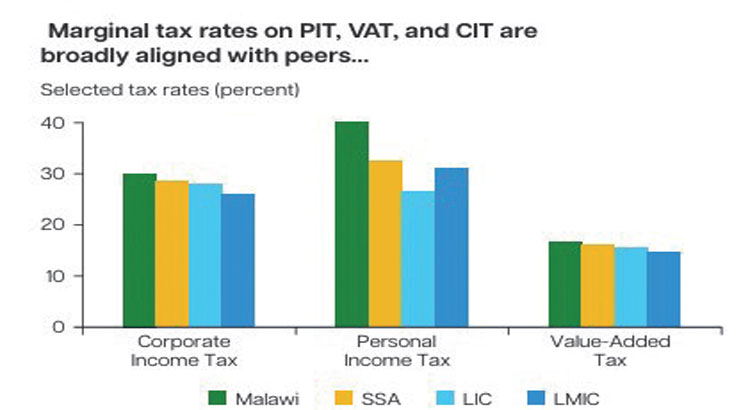
Estimates show that about 44 percent of household consumption is subject to VAT, reflecting extensive exemptions that have historically been used as a social policy instrument, according to the review.
Economics Association of Malawi president Bertha Bangara-Chikadza said in an interview on Wednesday that VAT reforms can restore fiscal discipline, but cautions that the outcome will depend on implementation rather than policy intent.
“The challenge in the past has not been policy design, but weak enforcement,” she said, urging authorities to remain alert to unintended consequences, including inflationary pressures,” she said.
Bangara-Chikadza, who teaches economics at University of Malawi, warned that VAT increases are likely to feed into prices over the next year through tax pass-through effects, interacting with already high food, fuel and fertiliser costs.
“The extent to which this becomes entrenched in inflation will depend heavily on monetary policy credibility,” said BangaraChikadza.
From a social-justice perspective, Centre for Social Concern economic governance officer Agnes Nyirongo argued that raising the VAT rate at a time households are still recovering from successive price shocks remains regressive.
“VAT is a broad consumption tax and because low-income households spend the largest share of their income on consumption items, they feel the impact far more than higher-income groups,” she said.
Nyirongo said that even small VAT adjustments can push up retail prices when the overall cost of living remains high, noting that households have not yet recovered from earlier inflation waves.
“Without strong compensatory social-protection measures, the reforms risk worsening financial pressure on already vulnerable Malawians,” she said.
The economists and World Bank’s views come as the government seek to implement VAT reforms outlined in the2025/26 Mid-Year Budget Review Statement presented by Minister of Finance, Economic Planning and Decentralisation Joseph Mwanamvekha in Parliament in November and the 2024 VAT amendments, which expanded the tax base by lifting exemptions and zero-rating on selected goods.
Newly taxed items include animal products, water, poultry feed, laundry soap, buses and some construction-related materials.
While the World Bank argues that broadening the VAT base is critical to improving efficiency and credibility, the reforms have triggered concerns about their distributional impact and inflationary consequences.
Beyond households, the World Bank review highlights that VAT exemptions are skewing the burden across firms, weakening VAT’s redistributive role.
In its July Article IV statement, the International Monetary Fund (IMF) backed VAT system reforms, but added that lasting revenue gains will depend on both tax policy and administration.
The IMF said short-term revenue objectives, including mobilising revenue from the informal economy could be achieved through indirect taxation, particularly by broadening the VAT base.